
What We Test For, and Why — Part 1: Deafness, the Cost of the Coat
A straight answer on Dalmatian health and genetics. Deafness runs through the breed — not through bad lines. Here is what the science actually says, what BAER testing tells you, and what no breeder website will admit about patches and the show ring.
What We Test For, and Why — Part 1: Deafness, the Cost of the Coat
A straight answer on Dalmatian health and genetics
Most breed health pages read the same way. A list of conditions, a reassurance that the breeder screens for all of them, and a photograph of puppies in a basket. It tells you nothing, because it is designed to tell you nothing.
This page is written differently, because the Dalmatian is an unusual breed to buy into and you deserve to understand what you are actually taking on. Two of the breed's defining health issues are not rare, not mysterious, and not a matter of luck. One of them is present in every purebred Dalmatian alive, including ours. The other affects roughly a third of the breed and can be identified in a puppy before it leaves for its new home.
That combination — serious, common, and measurable — is rare in purebred dogs, and it is genuinely good news. It means a careful buyer can evaluate a breeding program on evidence rather than on impressions. What follows is what we test, what the tests actually tell you, where the honest limits are, and what you should ask any breeder, including us.
Deafness: the cost of the coat
Why it happens
The spots are the reason. That is the uncomfortable truth at the center of Dalmatian health, and it is worth understanding properly rather than in outline.
Dalmatians carry the extreme piebald gene, which suppresses pigment across most of the coat. The white you are looking at is not a color — it is the absence of one, produced by a shortage of the pigment-producing cells called melanocytes. Those same cells are not confined to skin and hair. They are also required in the inner ear, in a structure called the stria vascularis, where they maintain the chemical environment that the hearing apparatus depends on to function.
A puppy born without melanocytes in that structure produces a cochlea that develops normally at first and then degenerates within the first few weeks of life. The deafness is permanent, it is present before the puppy's ears ever open, and nothing about whelping, care, or environment causes or prevents it. It is written into the same genetics that produce the coat people fall in love with.
This is why deafness runs through the breed rather than through particular bad lines. It is intrinsic. Any breeder who tells you their dogs do not carry deafness risk is either uninformed or not being straight with you.
The numbers
The figures most commonly cited in the veterinary literature, drawn from large testing databases, put roughly 8% of Dalmatians as bilaterally deaf — deaf in both ears — and around 22 to 24% as unilaterally deaf, hearing in one ear only. Call it just under a third of the breed affected in some way.
Those two categories are enormously different in practice, and conflating them is the most common error people make when they read about this.
A unilaterally deaf Dalmatian is, for the vast majority of pet homes, a completely normal dog. It hears you, responds to its name, learns commands, and lives an ordinary life. What it loses is the ability to localize sound — to tell you which direction a noise came from. Most owners of unilateral dogs would never have known without a test. The practical implications are modest: more care near roads, more care in off-leash situations where a recall depends on the dog orienting toward you, and awareness that a dog approached from its deaf side while sleeping may startle.
A bilaterally deaf Dalmatian is a different proposition entirely, and requires an owner who has chosen that commitment with open eyes. These dogs can live happy lives with training built on hand signals and vibration cues, and there are people who do this well and love doing it. But it demands a secure environment, considerable patience, and a realistic understanding that the dog cannot hear a car, a warning, or a call. It is not a dog for a first-time owner, and it is not something that should be discovered after purchase.
BAER testing, and why "the vet checked him" is not an answer
You cannot detect unilateral deafness by observation. This is the single most important practical fact on this page.
A puppy deaf in one ear behaves normally. It startles at noise, turns toward the food bowl, and responds to a clap. Breeders who test puppies by making a sound and watching the litter react are identifying, at best, the bilaterally deaf ones — and even that is unreliable, because a bilaterally deaf puppy in a litter of hearing littermates follows the others and appears to respond.
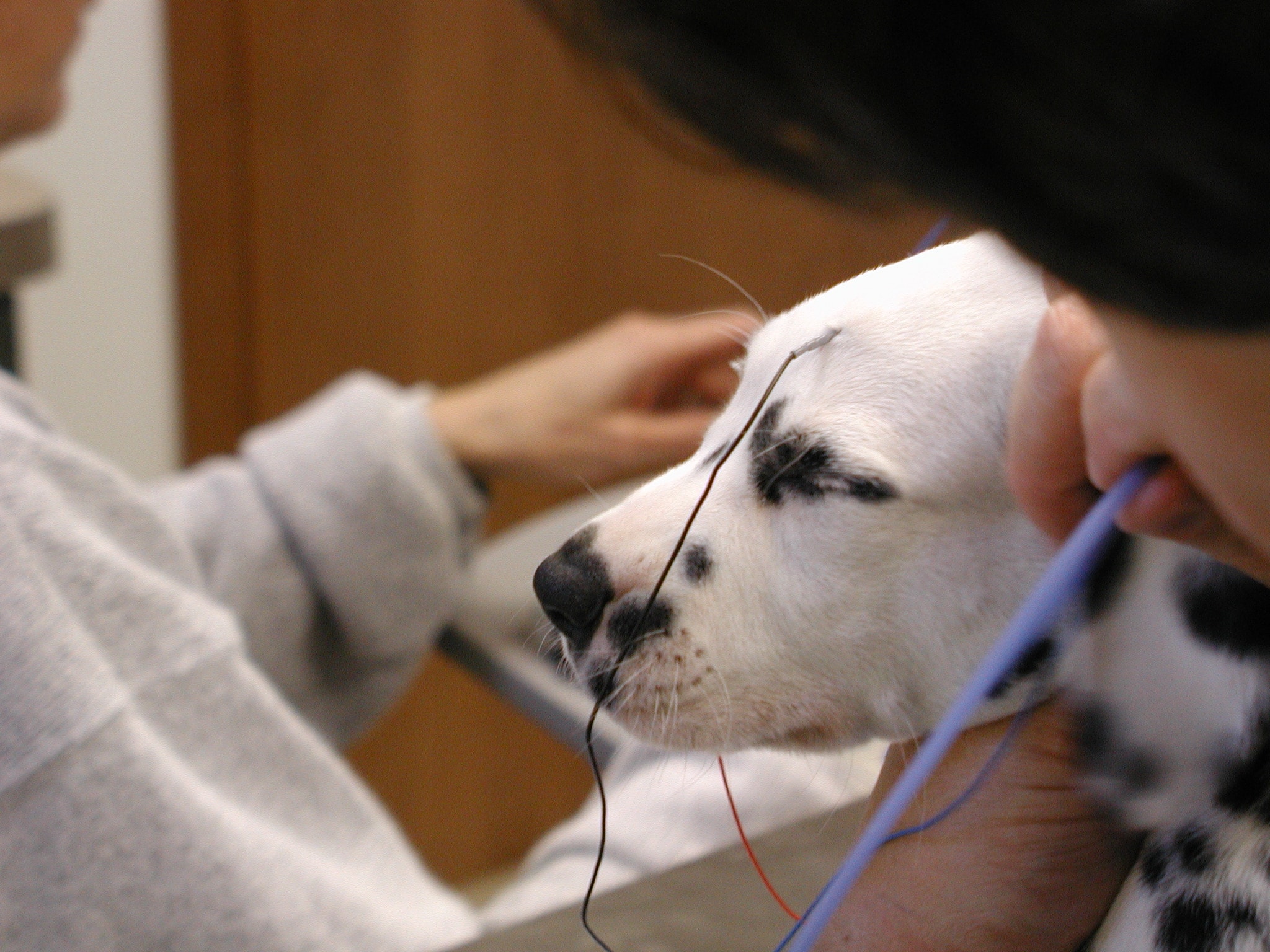
The only reliable test is BAER — Brainstem Auditory Evoked Response. Small electrodes placed under the skin measure the electrical response of the brainstem to a sound delivered into each ear separately. It is quick, it does not usually require sedation in a young puppy, and it gives an unambiguous ear-by-ear result. It is normally performed at around five to six weeks of age, once the auditory pathway has matured enough to give a clean reading.
Every puppy we place is BAER tested, and you receive the certificate for your individual puppy. Not a litter summary, not a statement that the litter was tested — the document for your dog, with its ear-by-ear result.
Ask for the same from any breeder you speak to. Ask for the parents' results too. A breeder who tests puppies but not breeding stock is doing half the job.
The two things that complicate the picture
Blue eyes. Blue eyes in a Dalmatian reflect the same pigment shortage, and the association with deafness is well documented. This does not mean a blue-eyed Dalmatian is deaf — plenty hear perfectly — but the correlation is real, and it factors into breeding decisions.
Patches. Here the breed runs into an awkward conflict between the show ring and the breed's health. A patch is a solid area of color present at birth, distinct from the spots that develop later. Patched dogs have a measurably lower incidence of deafness, which follows directly from the pigment explanation: more pigment, more melanocytes, better odds in the inner ear.
Patched dogs are also a disqualification under the breed standard in the conformation ring.
So the show standard selects, in a small but real way, against a trait that protects hearing. This is not a scandal and it is not a secret — it is openly discussed within the breed — but it is the kind of thing that rarely makes it onto a breeder's website, and you should know it. A patched puppy from health-tested parents is a perfectly sound pet with slightly better hearing odds than its littermates. It simply cannot be shown.
Part 2 covers uric acid metabolism, urate stones, and the LUA question — including HatTrick's own history with the Backcross Project and where we stand today.
Explore Topics
Enjoyed this post?
Share it with fellow Dalmatian lovers
Written by
HatTrick Dalmatians
Content creator and writer sharing insights and stories.
